

If you’ve ever stood on the court wondering why your opponent is shouting three numbers before serving, you’re not alone. Pickleball scoring can feel confusing at first, but the core idea is simple: in traditional games, only the serving team scores, and matches are typically played to 11 points, with a 2-point lead required to win. This blog breaks down both traditional pickleball scoring and rally scoring in plain, easy-to-follow terms.
The sport’s popularity has exploded nationwide, and Houston is leading the charge. Pickleheads reports that Houston now has more pickleball facilities than any other U.S. city. If you’re getting into Houston pickleball, learning the scoring rules is the first step to playing with real confidence.
How Does Pickleball Scoring Work?
Pickleball scoring tracks two things: which team is serving and how many points each side has earned. In traditional (side-out) scoring, only the serving team can add a point; if the receiving team wins the rally, no point is scored, but the serve simply changes hands. Games are usually played to 11 points, win by at least two. The server announces the score before each serve, which keeps both teams oriented and rewards consistent serving and defense. Mastering these rules will also help you feel more prepared when competing in pickleball tournaments near me.
Traditional Pickleball Scoring
Traditional scoring is the original and still most widely used system in recreational play, local leagues, and most tournaments. It’s built around the idea that points only come while your team is serving, hence the nickname “side-out scoring.”
Basic Scoring Rules
Only the serving team can score a point in traditional scoring. Games are typically played to 11, though tournament formats may go to 15 or 21. A team must win by two clear points, so a score like 11-10 simply continues until one side pulls ahead. If the receiving team wins a rally, the serve passes over instead of a point being awarded.
Serving and the Two-Serve Rule
Understanding pickleball serving rules starts with the two-serve rule. In doubles, each team gets two servers before the serve passes over, meaning both partners get a turn before a “side out” occurs. The exception is at the very start of the game: the first serving team only gets one server before losing the serve, balancing out the advantage of serving first. This small quirk trips up a lot of newcomers.
Singles vs. Doubles Scoring
Pickleball doubles scoring involves the two-server sequence above, plus a three-number score call. Singles is simpler: there’s only one server per team, so the score is called with two numbers followed by the server number, always one. Court positioning also differs, since singles players serve and return diagonally without tracking a partner’s position.
Serving Sequence
In doubles, the serve begins with the right-side player and moves diagonally with each successful point. When a side out occurs, the serve passes to the opposing team, and their right-side player begins serving. This rotation continues throughout the game, with players switching sides after scoring, keeping the sequence predictable once you’ve played a few games.
Calling the Score
Before every serve, the server calls out three numbers in doubles: the serving team’s score, the receiving team’s score, and the server number (1 or 2). A call of “4-2-1” means the serving team has 4 points, the opponents have 2, and the first server is up. Calling the score loudly and clearly prevents disputes and keeps the game moving.
Traditional Scoring at a Glance
- Only the serving team scores points
- Games are usually played to 11, win by 2
- Doubles teams get two servers per side out (except the first team)
- The score is called before every serve
- Singles uses a two-number call; doubles uses three
Read More: How to Score in Pickleball
Rally Pickleball Scoring
Rally scoring is a newer format designed to speed up matches and make game length more predictable. It’s increasingly used in certain tournaments and time-limited recreational settings, though traditional scoring remains the standard for most sanctioned play. If you’re interested in mastering both scoring formats, pickleball lessons near me can help you build the skills and confidence to compete in any style of play.
How Rally Scoring Works
In rally scoring, either team can score a point after every single rally, regardless of who served. Games are commonly played to 15 or 21 points, and this format moves faster since points aren’t lost to side outs. It’s a popular choice for pickleball league play on a tight schedule, since match times become more predictable.
Serving Rules in Rally Scoring
Unlike traditional scoring, each server typically gets only one serve attempt before the ball passes to the next server, rather than two per team. The serve still rotates between partners and teams, but since both sides can score regardless of who’s serving, the pressure around serving is lower.
Court Position and Serving Rotation
Players still switch sides of the court after their team scores while serving, similar to traditional play. The rotation of servers follows a set order, with points simply accumulating more quickly on both sides.
Rally Scoring Example
Imagine Team A serves and wins the rally: they score a point, 1-0, and continue serving. Team B then wins the next rally, even though they were receiving, so the score becomes 1-1, and the serve passes to Team B. This back-and-forth, regardless of who’s serving, is what makes rally scoring feel faster.
Traditional Scoring vs. Rally Scoring
Both systems get you to a final score, but they play out very differently on the court. Here’s a quick side-by-side look at how they compare:
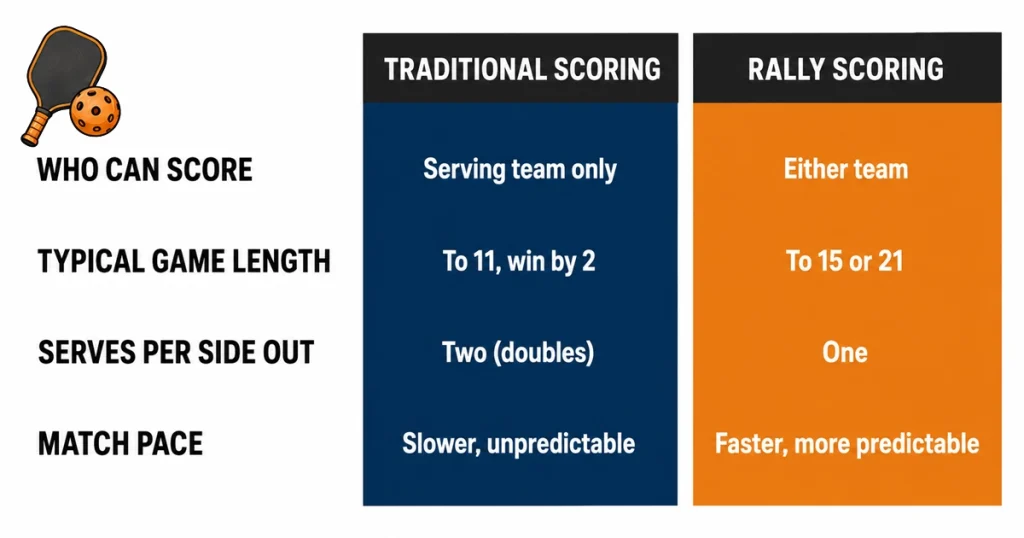
Rally Scoring at a Glance
- Both teams can score on any rally
- Games often go to 15 or 21 points
- One serve per player before rotation
- Common in time-limited leagues and some tournaments
Read More: Complete Breakdown of Pickleball Rules for Beginners
Common Pickleball Scoring Mistakes
Even experienced players occasionally mix up the rules. Here are the most frequent scoring mistakes beginners make:
- Skipping the full score call – Forgetting to call the complete three-part score before serving in doubles, which leads to confusion about whose serve it actually is
- Misjudging kitchen rules – Misunderstanding that stepping into the non-volley zone while volleying results in a fault, even though it happens away from the serve
- Missing the first-serve exception – Assuming both partners get to serve at the start of the game, when only one server is allowed before the first side out
- Mixing up singles and doubles sequences – Applying doubles serving rules to singles play (or vice versa), so it’s worth confirming the format before starting
If these mistakes sound familiar, a pickleball membership can give you regular access to coaching, practice opportunities, and skill development, helping you build confidence and make keeping score feel natural instead of confusing.
Master Pickleball Scoring With Confidence
Pickleball scoring isn’t complicated once you break it down: traditional scoring rewards consistent serving, while rally scoring keeps games moving faster. Knowing the difference between singles and doubles scoring, understanding the two-serve rule, and getting comfortable calling the score all help you play with confidence instead of second-guessing every point.
Whether you’re learning with a pickleball coach, joining a pickleball league, or looking for well-maintained pickleball courts, Casa Pickle is Houston’s home for pickleball and events — offering courts, leagues, and coaching for every level. Reach out and turn what you’ve learned here into real confidence on the court.