
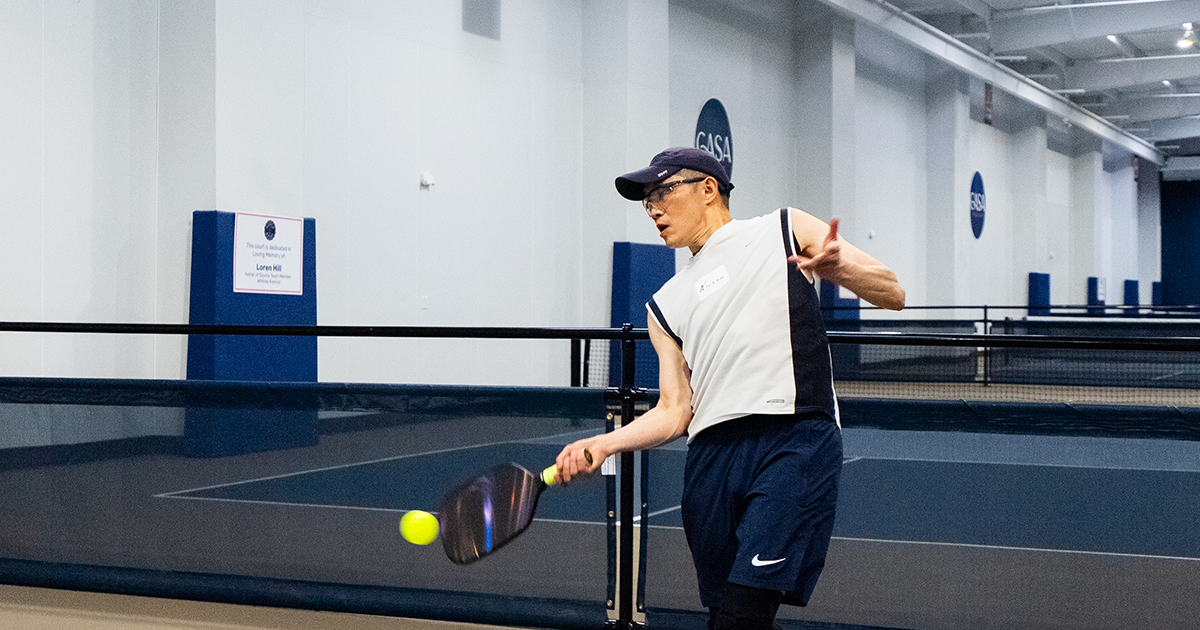
Pickleball is the fastest-growing sport in the United States, and while doubles dominates most club sessions and open play lineups, singles is gaining serious traction among players who want to push their individual game further. Playing one-on-one puts the entire court on your shoulders, with no partner to cover gaps and no shared serving responsibilities throughout the entire match.
Before stepping onto the court alone, knowing the official pickleball singles rules in full is what separates a confident player from a confused one. Whether you are just discovering the sport or a regular at your local Houston pickleball facility, this complete guide covers everything from serving and scoring to court positioning, key differences from doubles, and the most common mistakes to avoid.
What Is Pickleball Singles?
Pickleball singles is a one-on-one format played on the same standard 20×44-foot court used in doubles. Each player is solely responsible for covering their entire side of the court, which makes individual fitness, footwork, and shot selection far more important than in doubles. The official rules are governed by USA Pickleball and closely mirror the standard ruleset, but singles has its own specific serving mechanics and scoring structure that players must understand before competing.
Core Pickleball Singles Rules
These are the rules that directly define how singles is played and scored. Getting these right before you compete will save you from costly faults and avoidable errors during a match. If any of these rules feel unclear after reading, working with a pickleball coach is the fastest way to get them locked in before stepping onto a singles court.
1. Serving Rules in Singles
The serve must be made underhand with paddle contact below the server’s waist, directed diagonally into the opponent’s service court, and clearing the non-volley zone. Only one serve attempt is allowed unless a let is called. Stepping on or over the baseline before contact is a foot fault and results in an immediate loss of serve.
2. Serving Position Based on Score
In singles, your score determines which side of the court you serve from on every point. When your score is even, you serve from the right service court. When your score is odd, you serve from the left. This positioning rule is one of the most frequently misunderstood aspects for players who are transitioning from doubles to the singles format.
3. The Two-Bounce Rule
After the serve, the receiving player must let the ball bounce before returning it, and the server must also allow that return to bounce before playing their next shot. Only after these two mandatory bounces may either player volley the ball. This rule is identical in singles and doubles and prevents either player from rushing the net immediately after the serve.
4. Scoring in Pickleball Singles
Pickleball singles uses side-out scoring, where only the serving player can earn a point per rally. If the server wins, they score and continue serving from the correct side based on their updated score. If the receiver wins, they take over the serve, but no point is awarded. Games are typically played to 11 points and must be won by a margin of 2.
5. Non-Volley Zone (Kitchen) Rules
Players cannot volley the ball while standing inside the 7-foot non-volley zone on either side of the net, and this rule is the same in both singles and doubles. You may step into the kitchen to play a ball that has already bounced, but you must exit before volleying again. Carrying momentum into the kitchen after a volley also counts as a fault.
Key Differences Between Singles and Doubles
Singles and doubles use the same court and rulebook but demand completely different physical and strategic approaches. Mastering these differences is essential if you ever plan to compete in a pickleball tournament where singles formats are commonly featured.
Court Coverage and Physical Demand
In doubles, two players share court coverage, keeping individual movement manageable. In singles, you cover the full court alone. The most critical skills become:
- Fitness and stamina to sustain longer rallies
- Footwork to reach wide shots consistently
- Recovery speed to return to the center court after every single shot
Shot Selection and Playing Strategy
Doubles is largely dominated by soft dinking and net control, but singles demands a completely different game plan. Your primary weapons shift to:
- Deep baseline drives to push your opponent back
- Sharp cross-court angles to create open court space
- Well-timed lobs when your opponent crowds the net
Aggressive net approaches carry a higher risk in singles because a failed attempt leaves the entire baseline exposed with no partner to recover behind you.
Common Mistakes to Avoid in Pickleball Singles
Even experienced doubles players make predictable errors when switching to singles. The most common ones include:
- Serving from the wrong side by losing track of the odd and even score rule
- Hovering near the kitchen line too aggressively, leaving the baseline wide open
- Failing to recover to the center court after each shot
- Going for risky winners under fatigue instead of resetting with a controlled return
Fixing these habits early will save you unnecessary points and make your singles game far more consistent.
Play Pickleball Singles at Casa Pickle
Understanding pickleball singles rules is the first step, and mastering the format takes consistent practice, quality coaching, and courts built for serious play. Casa Pickle in Houston offers 26 premium indoor courts, professional coaching programs, and open play sessions designed for players at every skill level. Whether you are playing singles for the first time or preparing to compete, Casa Pickle’s coaches can help you build the movement, strategy, and consistency that singles demands. Book a court or explore all coaching options at Casa Pickle today.