
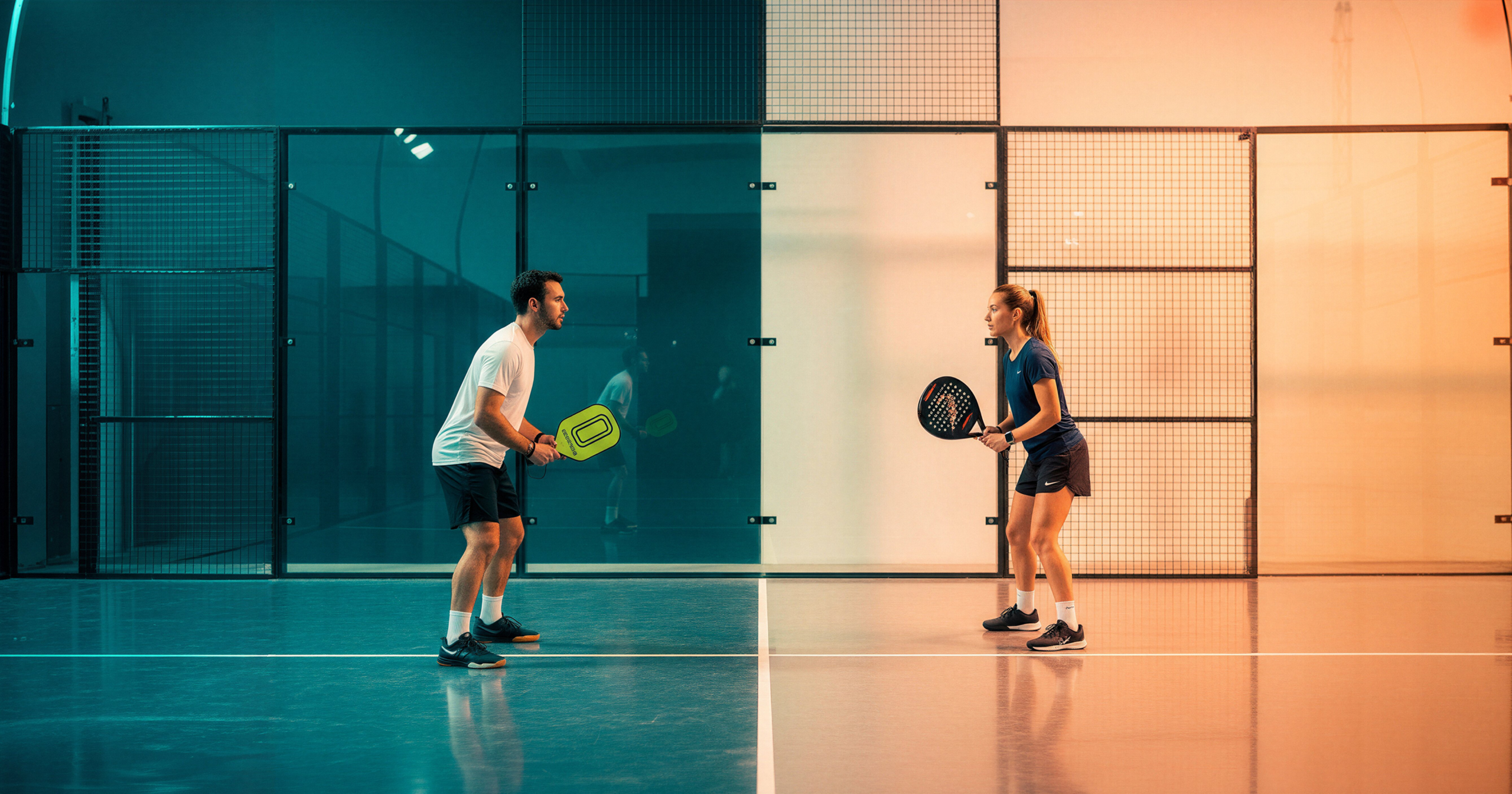
Padel vs. Pickleball are both popular, easy-to-learn racquet sports, but they differ in court design, equipment, and gameplay style. Padel is played in doubles on an enclosed court with glass walls that are part of the game, using solid rackets and a softer ball, leading to longer, more strategic rallies. Pickleball is played on a smaller open court with paddles and a perforated plastic ball, focusing on quick reactions, control, and fast-paced net play. While both are social and beginner-friendly, padel emphasizes wall-based tactics, whereas pickleball highlights positioning and precision. Choosing between padel and pickleball depends on your preferred style. Pickleball has also been growing in places like Houston, where many players are joining the sport for its accessibility and community vibe.
What is Padel?
Padel is a racquet sport that blends elements of tennis and squash. It was invented in Mexico in the late 1960s by Enrique Corcuera, and it is now one of the most popular racquet sports in countries like Spain, Argentina, and across much of Europe. Played mostly in doubles on an enclosed court, padel uses walls that players can hit the ball off, much like in squash.
The sport’s popularity has grown exponentially over the past decade. In fact, Spain alone boasts over 11,000 padel courts, with millions of fans and players regularly competing. Because the game’s court is smaller than a tennis court, players can get more involved in each point, making the sport fast-paced and highly strategic. Padel has recently started gaining ground in other parts of the world, including North America and the Middle East. Its unique combination of strategy and physicality makes it a sport suitable for people of all ages and fitness levels.
What is Pickleball?
Pickleball is another rapidly growing racquet sport, but it has a more recent origin. It was created in 1965 in Washington State, USA, by Joel Pritchard, Bill Bell, and Bobby Riggs. The game blends elements of tennis, badminton, and ping-pong. Pickleball is played on a smaller, non-walled court and uses a solid paddle and a plastic ball with holes (similar to a wiffle ball).
Pickleball’s simple rules and low-impact nature make it appealing to a wide range of players, especially beginners and older adults. Pickleball courts are appearing in parks, gyms, and recreation centers across North America, where the sport has exploded in popularity. The USA Pickleball Association (USAPA) reports that millions of people in the U.S. play pickleball.
While padel is gaining traction in Europe and other parts of the world, pickleball has dominated growth and participation in North America.
Padel vs Pickleball: Key Differences
Though both sports are based on racquet and ball play, they differ in several fundamental ways. Many players often explore both games at a pickleball club to better understand their unique playing styles and environments. Here are the key differences you should know:
Court Size and Design
- Padel courts measure about 20 m × 10 m, enclosed by walls, and they are half the size of a tennis court. The walls are an essential part of the game because players can use them to bounce the ball back into play, creating a dynamic that differs from most other racquet sports.
- Pickleball courts are much smaller, measuring approximately 13.41 m × 6.10 m. The court is open, with no walls, and has a net at the center. It is designed for ease of movement, and the absence of walls makes it a bit less complex strategically than padel.
Equipment Used
- Padel racquets are solid, perforated, and without strings, similar in size to tennis rackets but shorter and lighter. The ball used in padel is slightly depressurized compared to a tennis ball to keep the game faster.
- Pickleball paddles are smaller and made from wood or composite materials. The ball used in pickleball is hollow plastic with holes, which creates less bounce and requires more control when hitting.
Game Rules and Play
- Padel allows the ball to bounce off the walls of the court. This element adds complexity to the game and often forces players to take unusual or creative shots. The game is typically played in doubles and uses tennis-style scoring.
- Pickleball has a rule that forces the ball to bounce once on each side before players can hit a volley, and it uses a unique “kitchen” rule, a 7-foot non-volley zone near the net that players cannot enter to hit volleys. Scoring is typically to 11 points, and it’s played either in singles or doubles.
Padel Court vs Pickleball Court
The design of the courts plays a significant role in shaping how the game is played.
Padel Court Features
- Padel courts are enclosed by walls, and players can use these walls to hit the ball back into the court.
- The larger playing area allows for longer rallies, making padel more strategic, and the walls create more opportunities for trick shots.
Pickleball Court Features
- Pickleball courts have no walls, making them more open and straightforward in terms of play. The court is smaller, making it easier to cover and suitable for faster-paced games.
- The kitchen rule also creates a unique dynamic in pickleball, adding a layer of strategy around net play.
Padel vs Pickleball: Equipment Comparison
The equipment used in padel and pickleball significantly impacts how each sport feels:
- Padel: The racquet is solid, perforated, and smaller than a tennis racket. The padel ball is less bouncy than a tennis ball and is designed to have a lower bounce to match the smaller court and faster pace of the game.
- Pickleball: The paddle is smaller, usually made of composite or wood materials. The ball is made of plastic with holes that create a more predictable and slower bounce than a tennis or padel ball, adding an element of control and precision to the game.
Game Rules: Padel vs Pickleball
Though both sports are easy to learn, the rules can create very different dynamics:
- Padel:
- The game is played in doubles, and points are scored similarly to tennis.
- Players can hit the ball off the walls, using them strategically to increase the complexity of rallies.
- The game is played in doubles, and points are scored similarly to tennis.
- Pickleball:
- It can be played in singles or doubles.
- The ball must bounce once on each side of the net before players can volley it.
- Non-volley zones near the net make for intricate gameplay when approaching the net.
- It can be played in singles or doubles.
Which Sport is More Physically Demanding?
When comparing the physical intensity of both sports, it’s important to understand the demands of the court and the overall gameplay:
- Padel is generally more physically demanding because of the larger court size and the walls that add another level of complexity. Players need to be quick on their feet, with good endurance and agility, especially when reacting to wall bounces.
- Pickleball is more low-impact and is easier on the joints. The smaller court size and slower pace make it ideal for beginners and players looking for a fun, light workout.
Popularity of Padel vs Pickleball: Global Reach and Growth
In terms of global growth and popularity:
- Padel has seen a tremendous rise in Europe, especially in Spain and Italy, as well as in South America. It’s becoming increasingly popular in the U.S. and the Middle East.
- Pickleball has experienced explosive growth in the U.S., with millions of players across the country. It is also expanding into Canada and other parts of the world, thanks to its ease of play and low-impact nature.
Padel vs Pickleball: Which Sport Should You Try?
Your decision between padel and pickleball may come down to your personal preference for game style and physical intensity:
- If you enjoy dynamic, wall-based gameplay and are looking for a more intense, athletic challenge, padel might be for you.
- If you’re after a social, easy-to-learn game with low-impact physical demands, pickleball is a great choice.
Play Pickleball at Casa Pickle in Houston
If you’re in Houston and ready to experience pickleball firsthand, there’s no better place than Casa Pickle, the city’s premier indoor pickleball facility.
Premium Pickleball Facility
Casa Pickle features nine PPA-certified courts built with CushionX technology to ensure a comfortable playing surface that reduces joint stress. It’s an indoor, climate-controlled facility, meaning you can play year-round without worrying about weather conditions.
Community & Coaching
At Casa Pickle, the focus isn’t just on play; it’s about community. Whether you’re a beginner or an experienced player, some programs and clinics can help you improve your game. You’ll also meet a variety of players and get to experience the fun social aspect of pickleball.
Social Spaces & Events
Beyond pickleball, Casa Pickle offers plenty of lounge spaces, a bar, and ample space for social gatherings. The club also hosts events, tournaments, and corporate mixers, making it a fantastic place to network and socialize.
Membership Perks
Casa Pickle offers a range of membership options that come with priority court bookings, exclusive events, and access to professional coaching.
Which Is Right for You: Padel or Pickleball?
When it comes to deciding between padel and pickleball, both sports offer a unique blend of fun, exercise, and social interaction. Padel is ideal for those who enjoy a faster-paced game with complex strategies, while pickleball offers a more approachable, low-impact game suitable for people of all ages. If you’re looking to experience pickleball in Houston, Casa Pickle is the place to go. With its state-of-the-art courts, thriving community, and range of events, you’ll be able to enjoy pickleball no matter your experience level.